

|
|
|
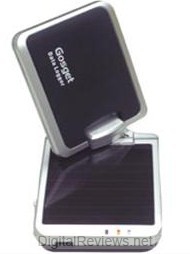
When F-tech became the first company to bring out a solar GPS receiver
well over a year ago, we all thought: Why didnt anyone think of that
before?!
Brilliant idea because most of the time the unit sits on the dashboard in full sunlight.
We reviewed that first unit, even gave a handful away in a competition
and now we present you the Mark II the follow up unit: shrunk in
size and more capable as you would expect.
What were our findings? |

Immediate comparisons with the rather bulky predecessor are quite
favourable. Its a decent size now, though not the smallest weve
reviewed.
Frankly, you do need that extra surface area for the solar
panels.
So its not too bulky anymore and compares well with other GPS receivers we tested.
The MediaTek chip is a gem: fast in acquisition, sensitive in even the
remote corners of our office, far away from windows and it keeps track
of 32 satellites for you. Not that youd need that many as a good fix
can be gotten with just 3 or 4 sats but the more satellites in view and
tracked the better it is as the constellation changes continuously.
The F-tech Solar Bluetooth GPS, also known as the BT2.5MR, is
unbranded. It only says Solar GPS on the back which makes it ideal
for OEM parties and other companies who want to bring out their own
receiver. Thats exactly what F-tech does so expect to see this one in
various implementations soon!

Testing
We have not done really extensive testing beyond the normal trips to
the office but did take it up in our aircraft as well, just as we do
with all GPS receivers. Why? Because not only did I start out to do
that from a professional pilots interest more than 4 years ago when
these things became available, but also because a large portion of our
readers have aviation interests. The F-tech Solar Bluetooth GPS
Receiver is EGNOS and WAAS enabled which is particularly important for
our American flying fraternity. Here in Australia WAAS is not
implemented so we have to do without the greater accuracy it gives.
Its interesting that the User Manual does not mention this capability,
nor will you find it on the generic box. However, John Yang of F-tech
(http://www.f-tech.com.tw) assured me of this fact.
The rest of the F-tech Solar Bluetooth GPS Receiver specifications are
fairly standard and on a par with what the rest of the industry has to
offer in their current models.
Battery Life
Heres where the F-tech Solar Bluetooth GPS Receiver really shines: great endurance, away from power sockets!
The book says 20 hours on its internal Li-Ion battery and up to 30 hours with the help from the solar panel.
Even though in my endurance tests it didnt quite get these numbers,
despite some great sunshine here in Australia, the end result is still
exceptional!
When the time comes to charge from mains, theres a very handy,
light-weight and small mains charger included, sporting an internal red
LED when connected. It even had (slanted) Australian prongs! Well done!
Also included in the box is a 12 Volts charger which is handy to keep in the glove box.

Improvements
Why do LEDs have to blink when a connection has been made and is OK?
Ive written about this many times before as blinking lights attract
(unwanted) attention to themselves which is totally unnecessary for
normal operation. Also, at night it becomes very annoying and I had to
cover the lights up for driving or flying at night! There should also
be an automatic light dimmer for operating the unit at night.
Conclusion
This is a great (and green) device if you have need for long battery
life and great sensitivity in detecting the weaker satellite signals.
With the suggested retail price of between the US80-90 mark, its good
value for many years of navigating the highways, the byways and the
airways
Note: stay tuned for another exciting product from the F-tech stable: the NAV 550 Professional Navigator.
We hope to review this device as soon as the Australian maps are ready for it probably within the next few weeks.

Technical Specification
1. General
Core Module: Built-in high performance MediaTek chipset solution
(MT3301+MT3 179). Satellite channel number: all-in-view 32 parallel
satellites;
GPS frequency: 1575.42 MHz
Receiver: L1, C/A code.
Antenna type: Built in low noise patch antenna
External connector: MMCX (standard)
2. Acquisition Time
Refresh: 1 sec
Cold start: 37 sec (average)
Warm start: 36 sec (average)
Hot start: 1 sec (average)
Position information update period: 1 Hz (average)
3. Precision/ Accuracy
Position accuracy: < 3m CEP (50%) without SA (horizontal) Velocity: 0.05 m/sec, without SA
4. Dynamic condition
Altitude: 18,000m (32,900 feet) Max Horizontal Velocity: 515 m/s Max Acceleration: 4G( G for gravity unit)
5. Power management
A) Applied External Voltage: 5V DC +/- 5% (via charge cable)
B) Power system:
Main battery: Rechargeable Lithium-ion 3 .7V battery, as main power. Solar Panel: auxiliary power provider
6. Protocol &Interface
Output format NMEA 0183 V3.01
|